Product · live application
What is in the application, screen by screen.
Six screens from the demo workspace: a fictional Belgian fintech with one credit-scoring model, classified high-risk under Annex III. Everything below runs today. The one thing that does not yet, the AI drafting, is marked as in build.
01 · Registry
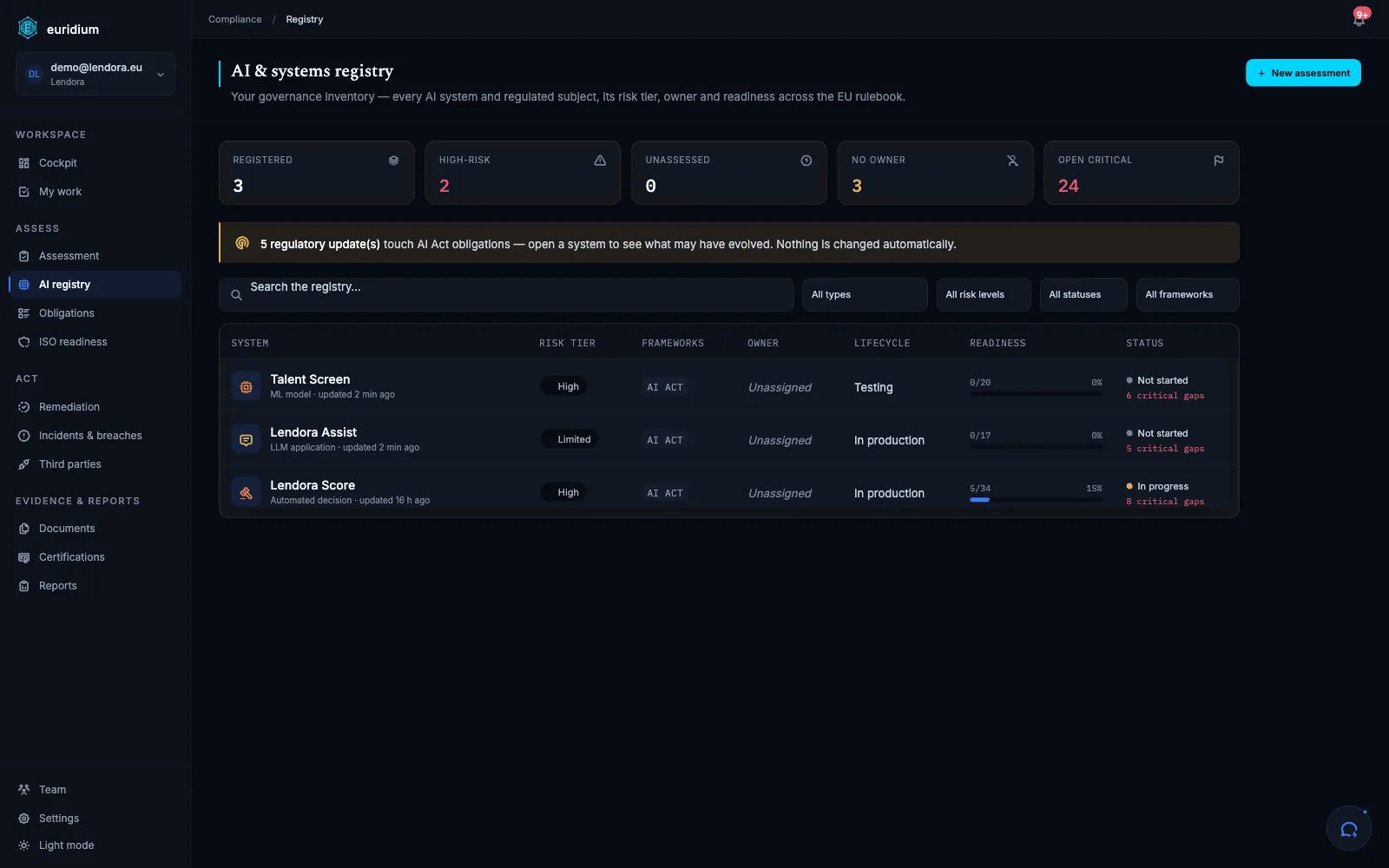
Every AI system, its regimes, its risk tier, its owner.
The inventory of systems and regulated subjects. Each row shows the frameworks that apply, the tier derived by the engine, the owner, the lifecycle stage and the readiness. A banner flags regulatory updates that touch its obligations; nothing changes on its own.
02 · Classification
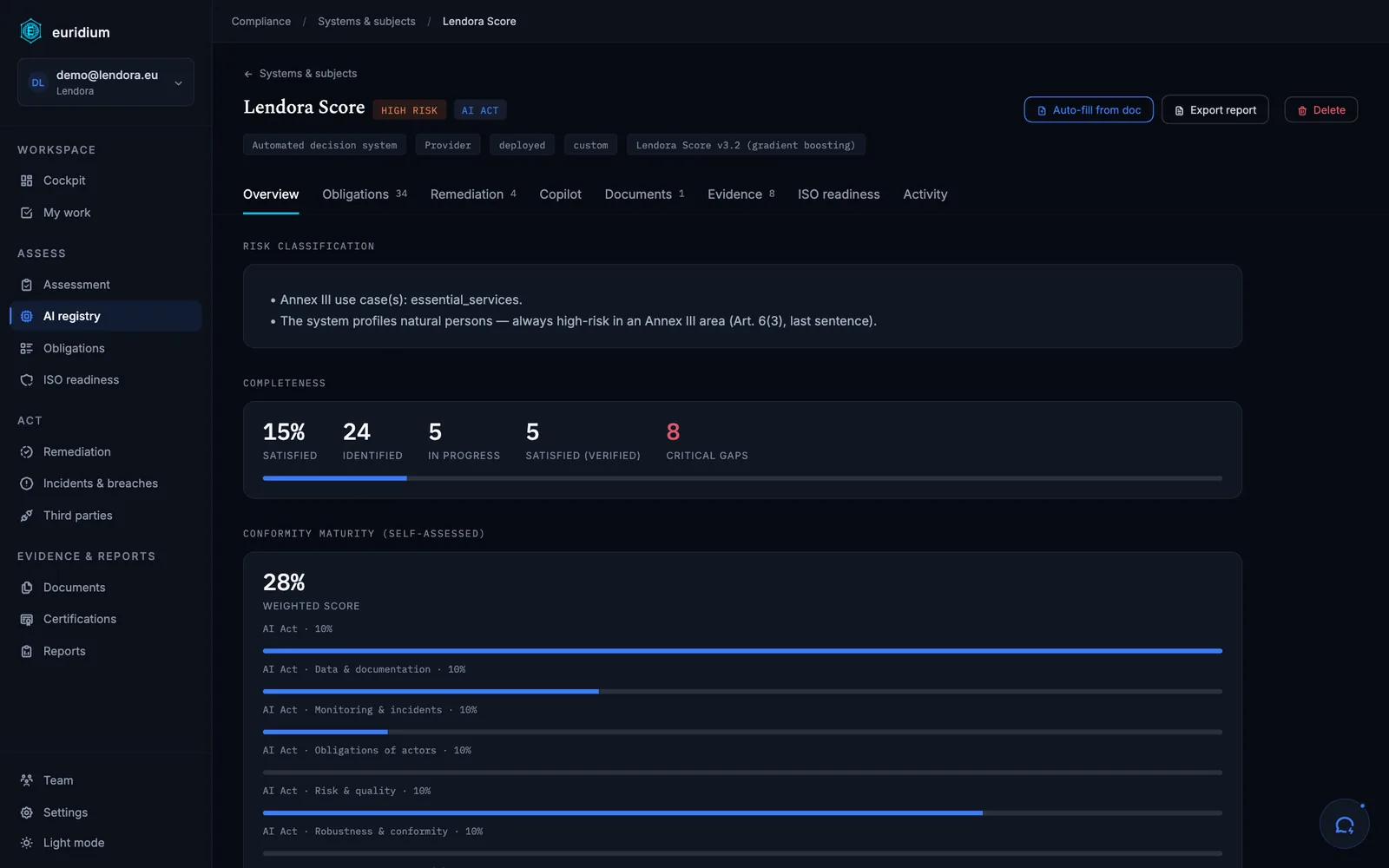
Why it is high-risk, in the regulation’s own words.
Annex I or Annex III, the Article 6(3) filter, Article 25 when a deployer becomes a provider, Article 2 exclusions. The rationale is written out. Two figures, never merged: obligations satisfied, and self-assessed maturity.
03 · Obligations
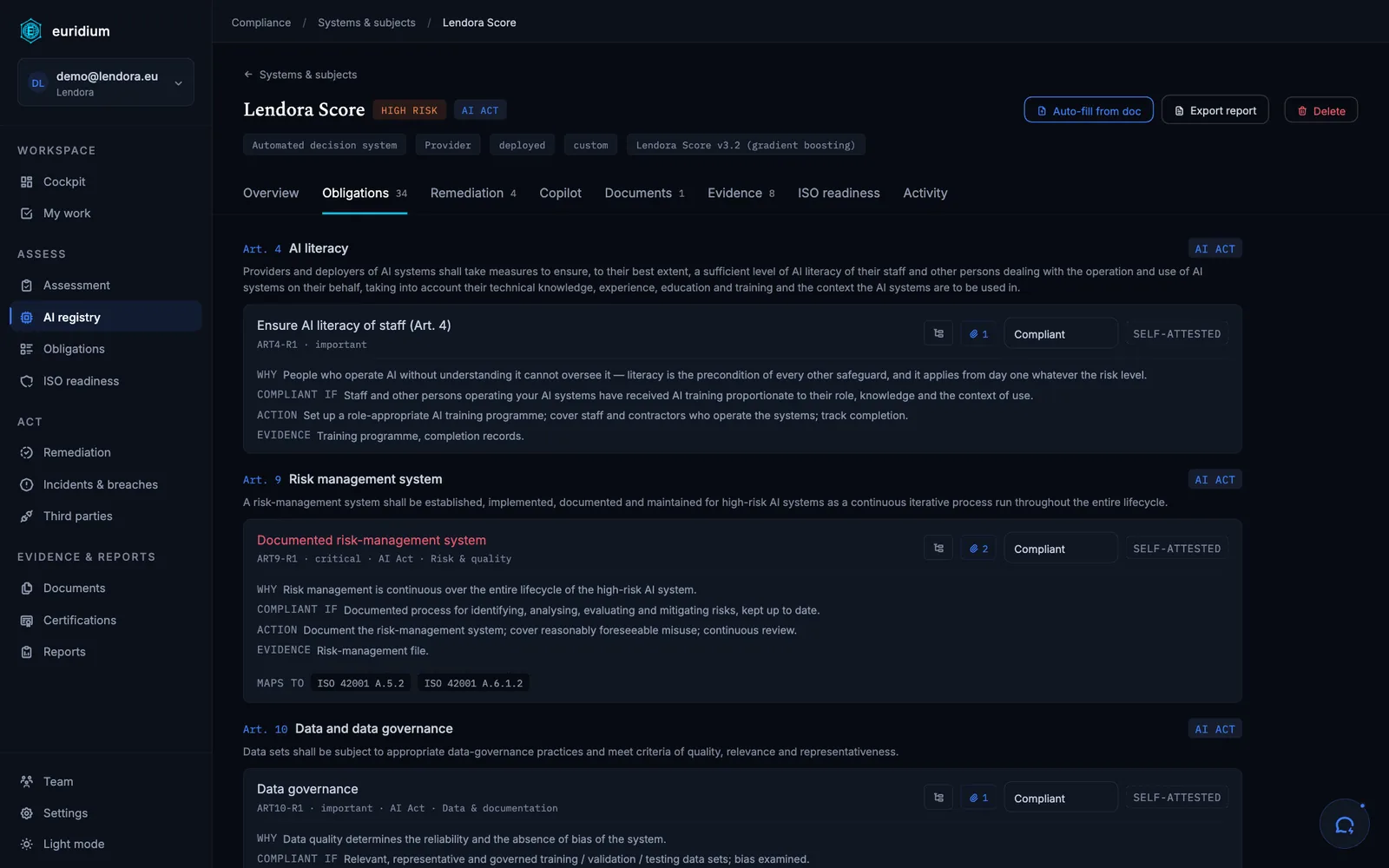
Article by article, with the proof expected.
Why it exists, when it is met, the action, the evidence expected, the ISO 42001 / 27001 mapping. “Compliant” is locked behind attached evidence and a signature; a one-person sign-off is marked as such.
04 · Evidence
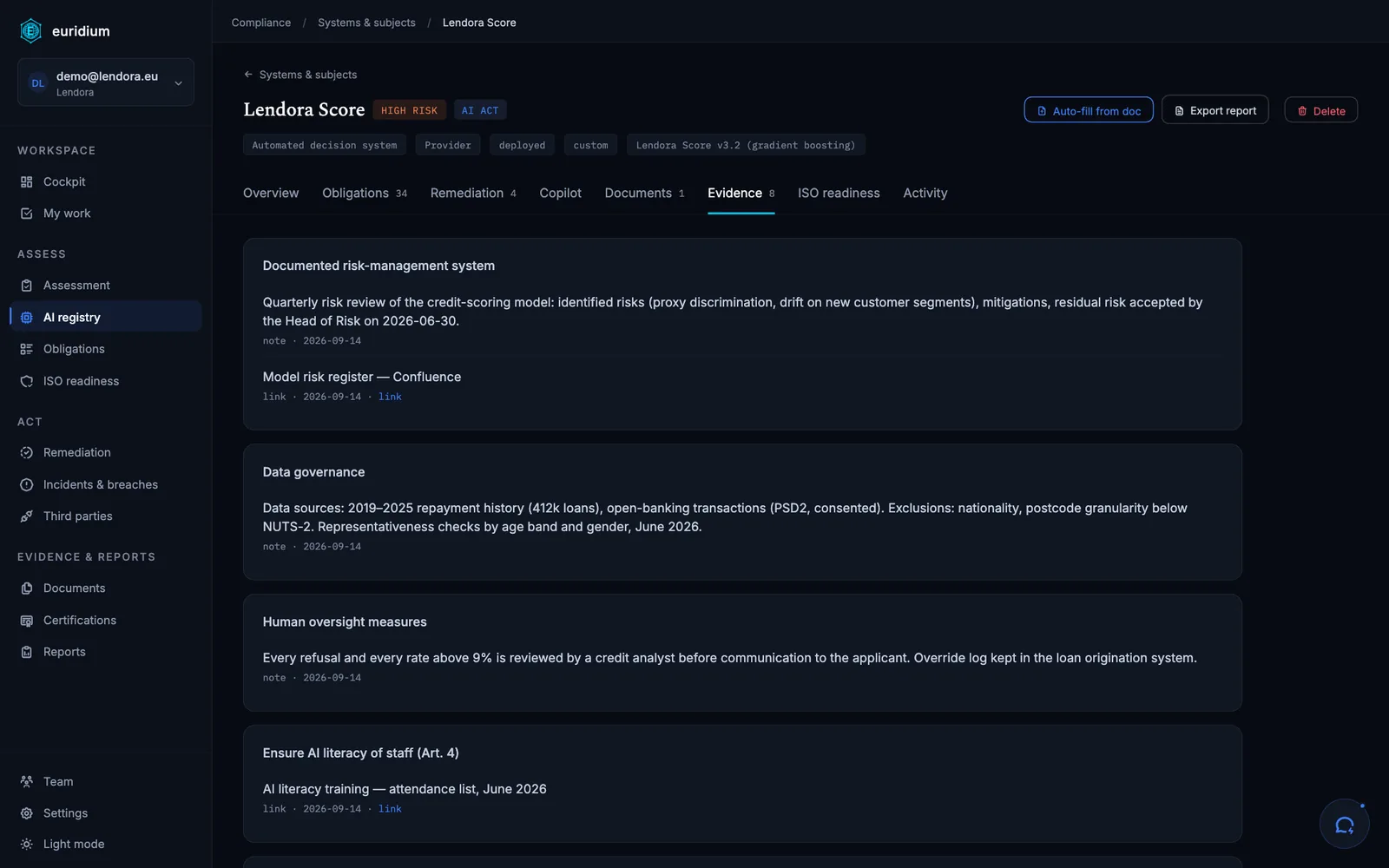
Captured once, counted everywhere.
A policy, a supplier contract, a model card, a training-data sheet: each item is dated and attached to every obligation it supports. Twenty-five control families link the obligations of eight regimes.
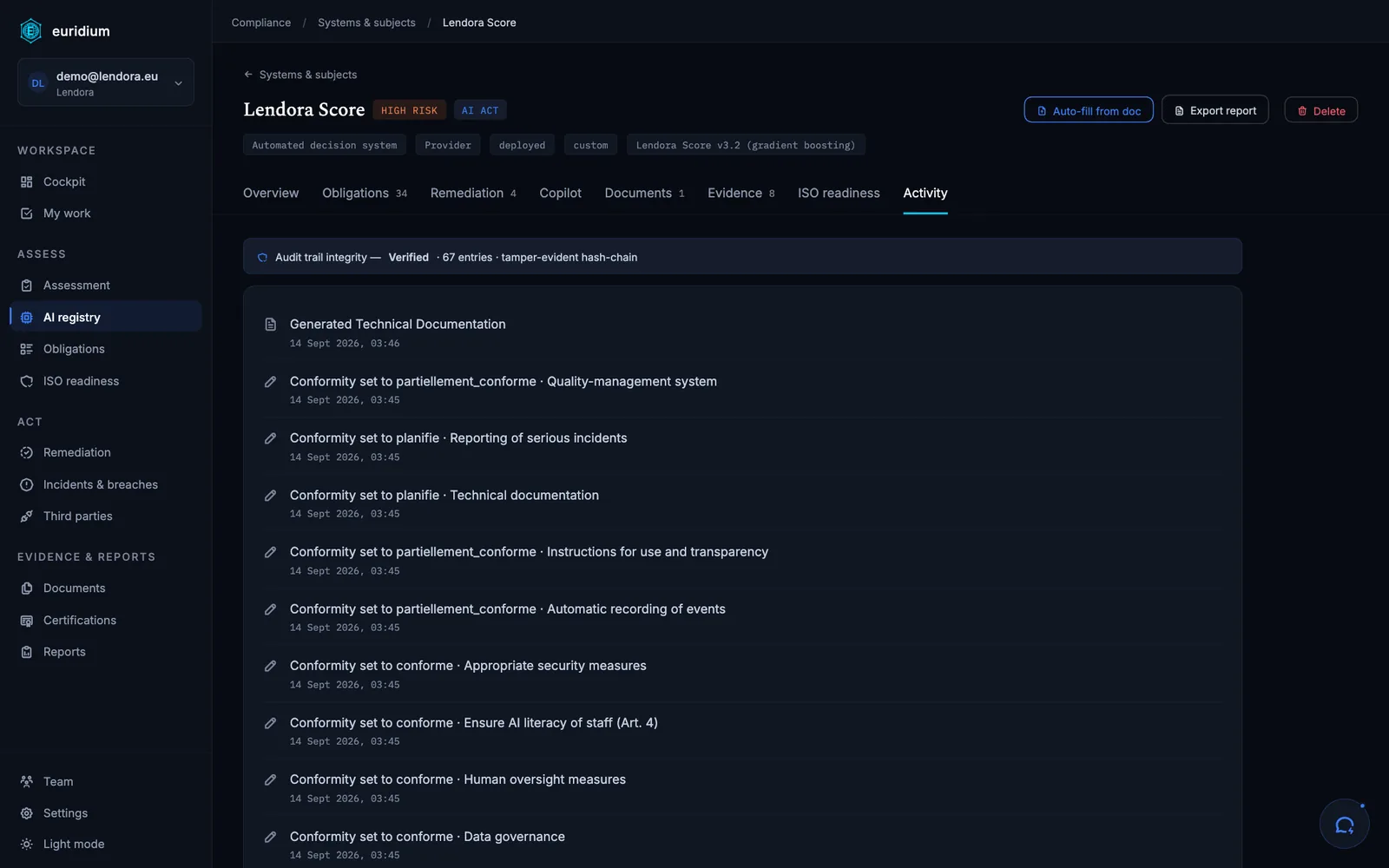
05 · Audit trail
Who did what, when, and proof nothing was altered.
Every action enters a chain of cryptographic hashes that anyone can verify. This is also what makes an AI-drafted file acceptable: the model proposes, the chain records who accepted what.
06 · The file
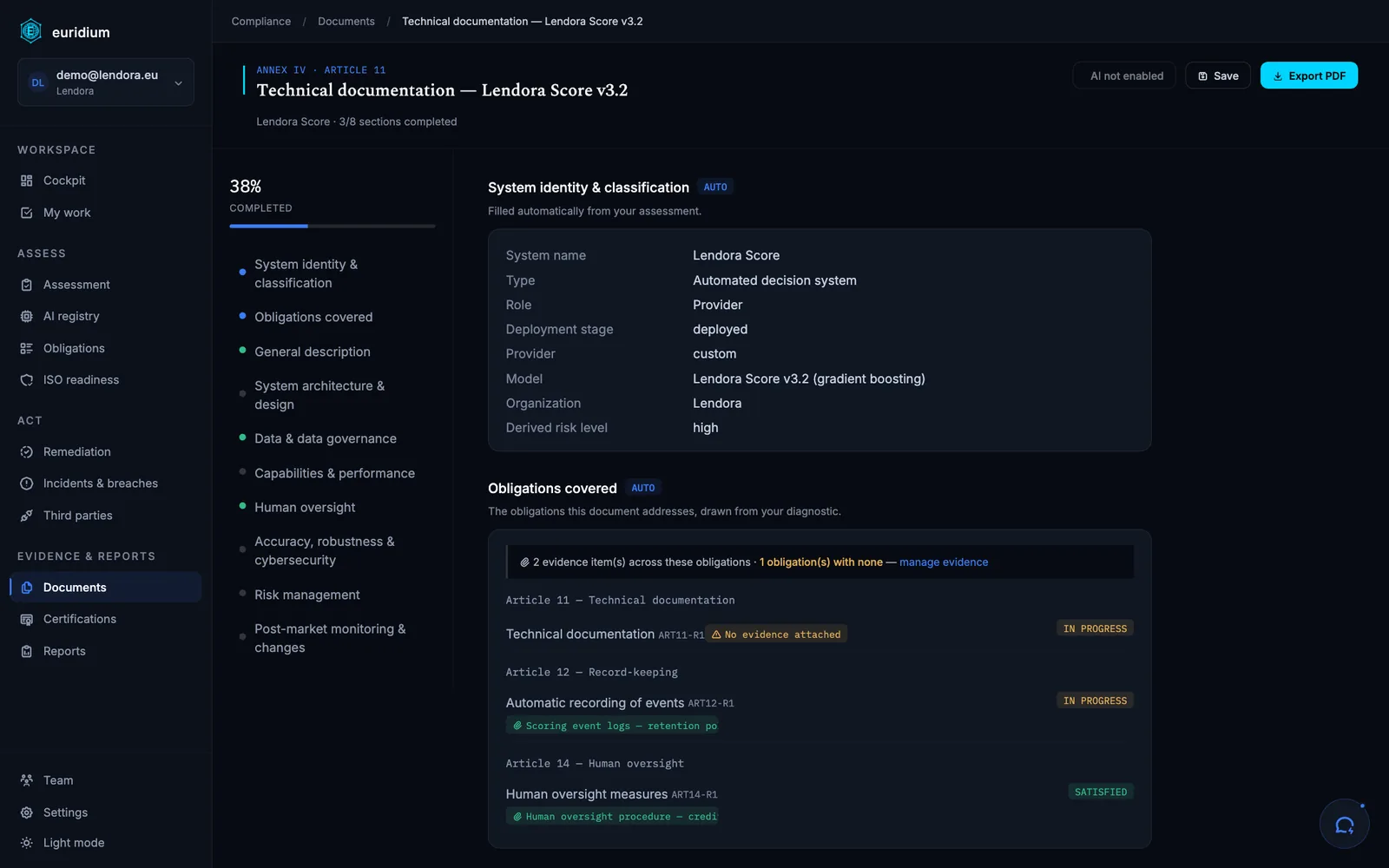
The Annex IV documentation, ready to hand over.
Section by section, tied to the obligations and the evidence behind it, exportable as PDF. Two sections are filled today from your assessment answers: system identity and classification, and the obligations covered. The AI drafting will fill the rest, each sentence citing the document it comes from.
The AI drafts each section from your documents, and cites the passage it used.
The model reads your policies, contracts and technical notes and fills the file section by section. Each sentence points to the passage it came from. If there is no source, the box stays empty and says which question to ask your team.
- It never signs. “Compliant” stays locked behind attached evidence and a human signature.
- It does not classify. Risk tiers stay deterministic, with the rationale written out, because a model’s output could not be audited.
- Documents sent to the model are not used to train it. The processors are named. The AI features can be switched off for a customer that wants it.
Audit trail
What the chain looks like.
Five entries from the demo workspace. Each block carries the hash of the one before it; change one entry and every later hash stops matching.
Compared
Against what companies use today.
| Euridium | Law firm | Spreadsheet | US compliance platforms | |
|---|---|---|---|---|
| Who reads the law | A catalogue written from the regulation, obligation by obligation, with the evidence each one expects | A lawyer, once, at their hourly rate | Whoever built the spreadsheet | A control framework translated from US norms |
| Who writes the file | Today: your team, against the obligations. Next: the AI, from your documents, every sentence sourced | The lawyer, by hand | You | You, against a checklist |
| When it is updated | When a document or a rule changes: only what is touched reopens | When you pay again | When someone remembers | On a control review cycle |
| What an auditor gets | A dated, signed file with a verified hash chain | A PDF | A spreadsheet | Control evidence, not the regulatory file |
| Certifies | Never. Readiness only | No | No | Some issue a badge |
A fair reading, not a scorecard. A law firm is the right answer for a contested question; a US platform is the right answer for SOC 2. Euridium is the answer for the EU regulatory file that nobody in the company has time to write.
Walk through it on a call.
Thirty minutes, screen shared, on the demo workspace or on a system of yours. Then a workspace, a first system, and the obligations that are actually yours.