Compliance software · EU AI Act · Brussels
When the auditor asks for your AI Act file, it already exists.
Euridium registers each AI system, classifies it under the EU AI Act, lists the obligations for your role, and keeps the evidence, the sign-offs and the audit trail together. One file per system, ready to hand over.
Live: registry, classification, obligations, evidence, sign-off, audit trail In build: AI drafting of the file, December 2026
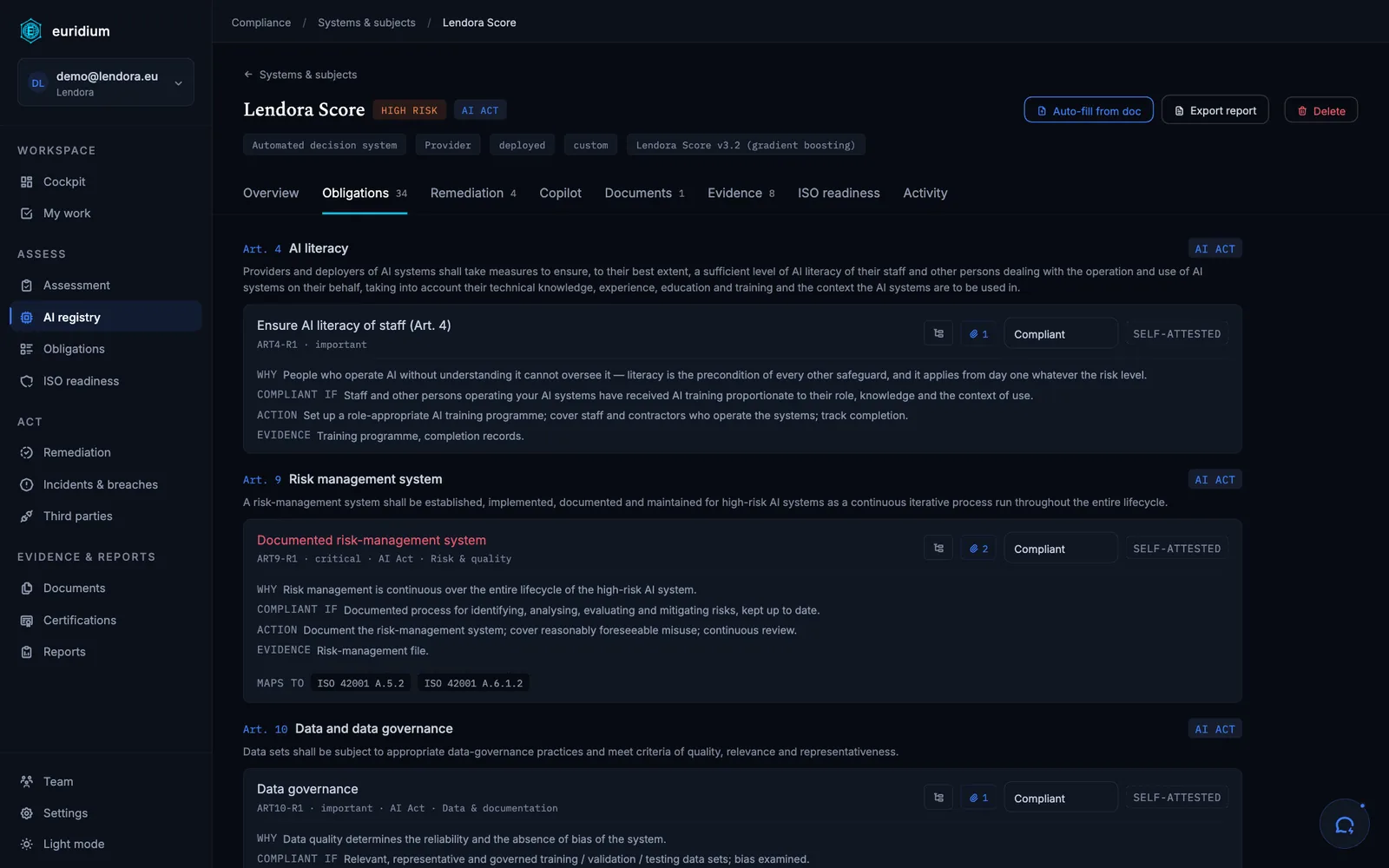
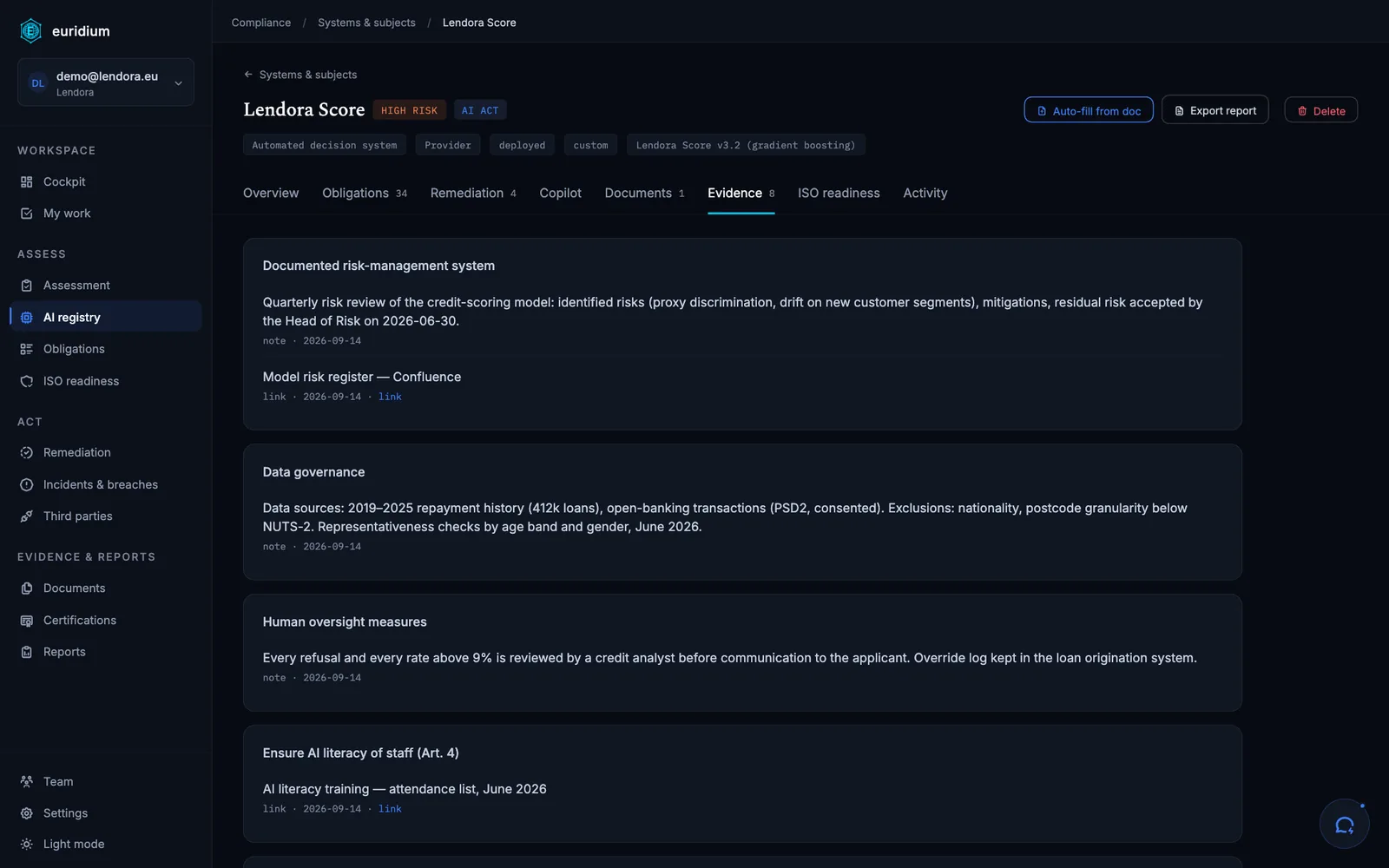
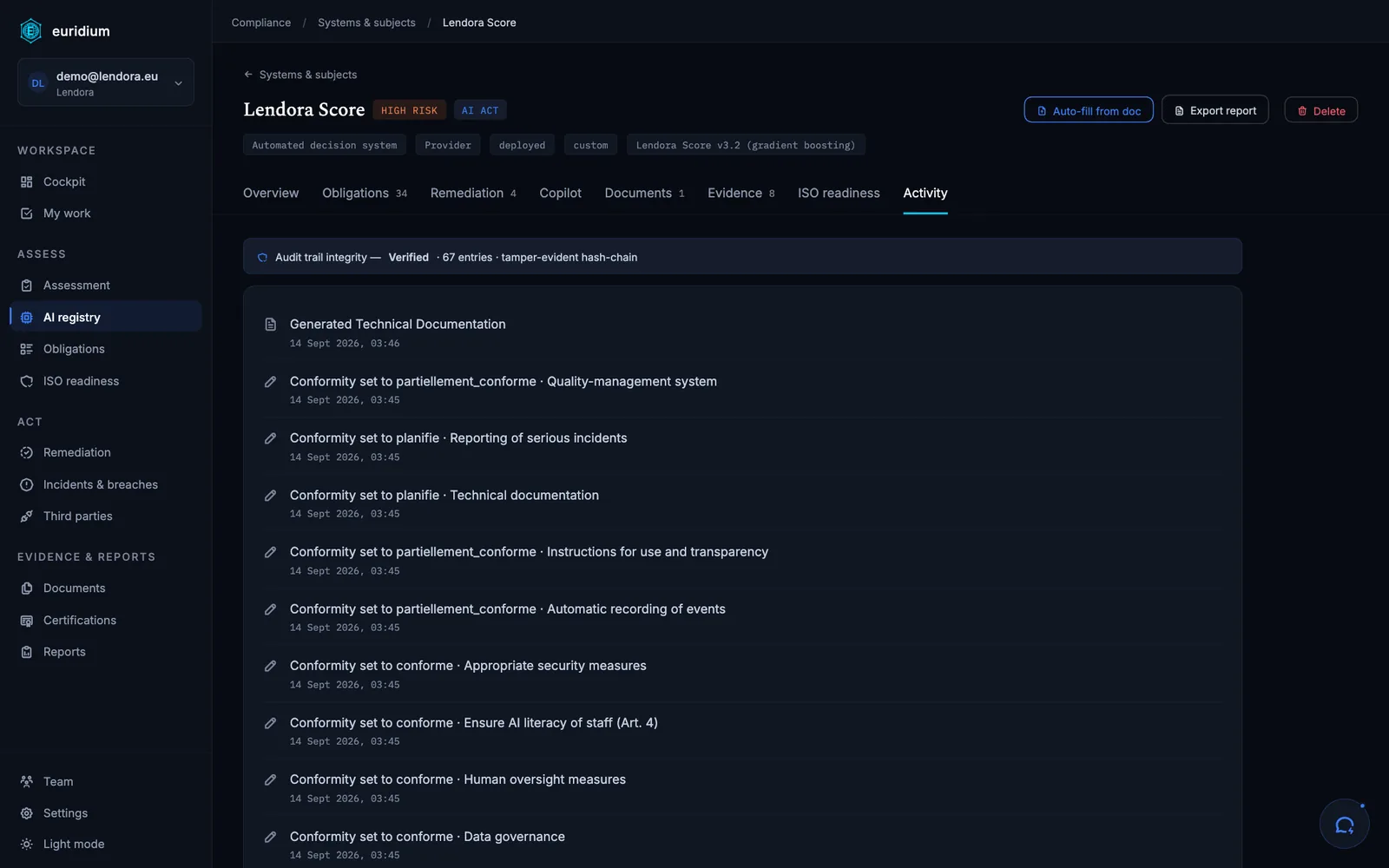
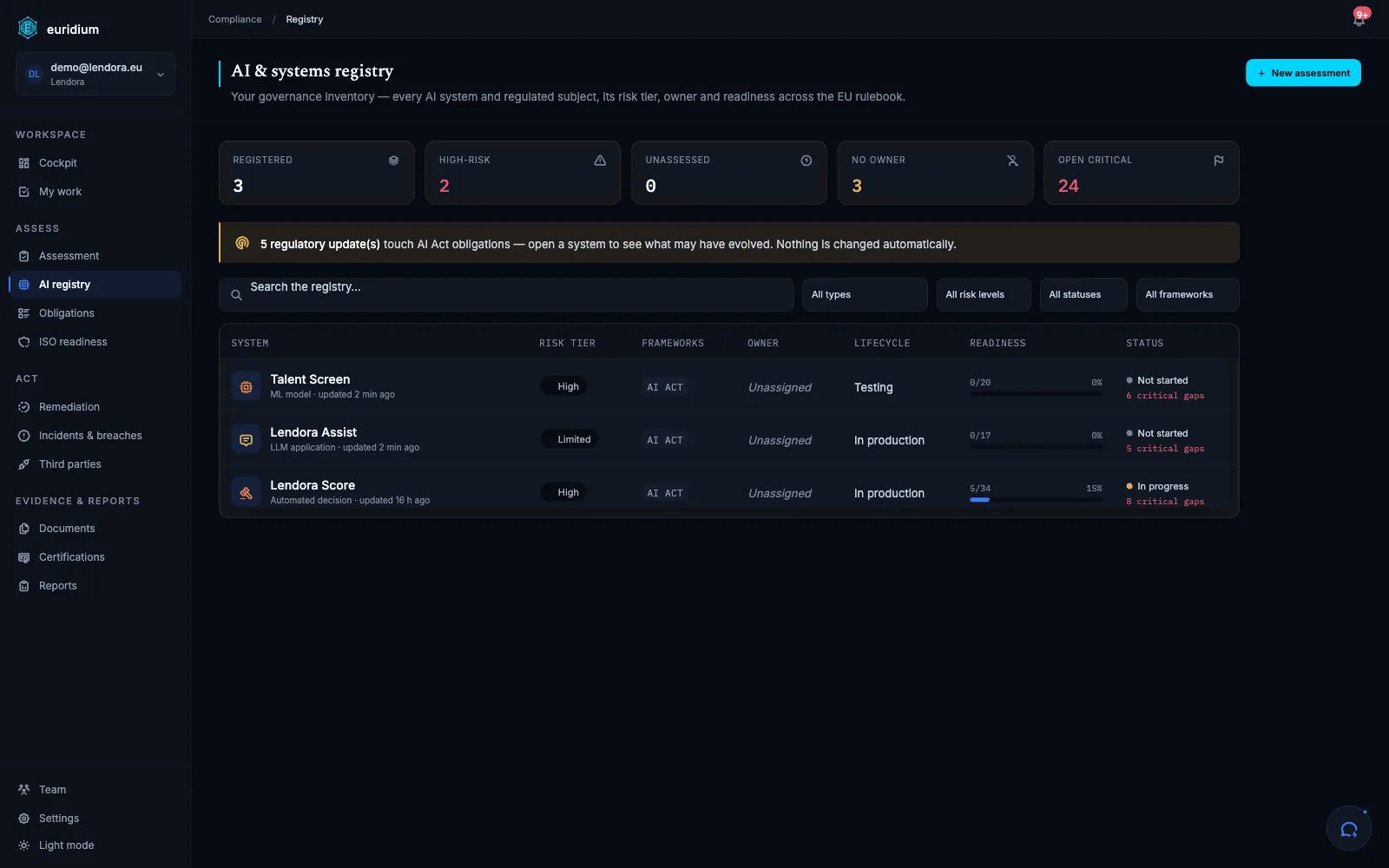
Obligations · Lendora Score · 34 obligations under the AI Act · 5 self-attested
Next: the AI writes the first draft from your documents.
Policies, supplier contracts, model cards, technical notes. The model reads them and drafts each section the law expects, every sentence linked to the passage it came from. Where it finds nothing, it writes nothing and says which question to ask your team.
- Drafts with sources, or not at all
- Never signs: “Compliant” stays locked behind evidence and a person
- Never classifies: risk tiers stay deterministic and auditable
- First demonstration in December 2026, on the real documents of the first pilots
Live today
What the application already does.
Everything below comes from the demo workspace, a fictional fintech with three AI systems. Nothing is a mock-up.
Registry & classification
Each system gets a risk tier, and the reason is written out.
Same answers, same tier, every time. No language model anywhere near that decision.
Obligations
Thirty-four obligations for one high-risk model, each with its test.
Why it exists, when it is met, what evidence is expected, the ISO 42001 mapping.
Evidence
One document counts for every obligation it covers.
Attach it once. It serves the AI Act today and DORA or GDPR later.
Sign-off
“Compliant” needs evidence and a named signature.
The database refuses anything else. A one-person sign-off is marked as such.
Audit trail
Every action enters a hash chain an auditor can verify.
Who did what, when. Nobody has to trust Euridium.
The file
The Annex IV documentation, section by section, as PDF.
Two sections are filled from your assessment answers today. The AI drafting will fill the rest.
- System identity & classification
- Obligations covered
- General description
- System architecture & design
- Data & data governance
- Capabilities & performance
- Human oversight
- Accuracy, robustness & cybersecurity
Coverage
The AI Act first. Seven other regimes in the same catalogue.
200 obligations across eight EU regimes, on the same objects. A regime is switched on when a customer needs it, never a separate tool.
How a file gets built
Three steps. At the end, a dated and signed file.
Register the system
Name it, answer the classification questions, name an owner. The engine derives the tier and the obligations for your role.
Attach evidence, sign
Upload the policy, the contract, the model card. Attach each to the obligations it covers. A named person signs.
Hand over the file
Export the Annex IV documentation and the audit trail. The chain proves nothing was changed after the fact.
Why now
The AI Act obligations land in waves.
Prohibited practices, AI literacy
Unacceptable-risk uses banned; staff must be AI-literate.
General-purpose AI
Obligations for GPAI model providers, governance, penalties.
Transparency
Chatbots must say so; synthetic content and deepfakes must be marked.
High-risk systems
Credit scoring, insurance pricing, recruitment, education, essential services.
AI inside regulated products
AI as a safety component of machinery, medical devices, vehicles.
An Annex IV file takes months to assemble. The companies that buy from you have already started asking for it.
Provider or deployer: which file is yours →Dates as amended by Regulation (EU) 2026/1744. Always confirm against the Official Journal.
Who it is for
Two kinds of companies, the same file.
Companies that build or run AI, without a legal team
Fintechs, AI providers, HR and health software, insurtechs. Twenty to two hundred people, AI in the product, compliance landing on the CTO.
- A December 2027 deadline that cannot be missed
- Clients already asking for the AI Act file
- No budget for a law firm, no time for a spreadsheet
Banks and insurers, together with their suppliers
A financial institution must verify its AI and ICT suppliers under the AI Act and DORA. A bank pilot starts with its own systems; the supplier side follows.
- Belgian finance first, where auditors and budgets already exist
- Proof requests to suppliers, free supplier profile In build
- DORA register of information In build
One law, twenty-seven countries
The same regulation from Lisbon to Tallinn.
The AI Act reads the same in every member state, so a file produced in Euridium works in any of them. We start in Belgian finance and sell in Europe.
Pricing
Launch pricing, indicative.
Per regime and per system. Hypotheses until the first pilots confirm them; founding customers keep the terms they sign.
A company without a legal team. One regime, a few systems, self-serve.
A bank, insurer or lender with several high-risk systems and an auditor to satisfy. Supplier proof requests and the DORA module are in build.
Paid for by the buyer that requires it. The way suppliers will join. In build
See it on one of your own systems.
Thirty minutes on the demo workspace, or on a system of yours. The application, not slides. Or start with the free check: six questions, no account.

I trained companies on this regulation for a year before building anything. Nobody in those rooms needed another explanation of the AI Act. They needed the file written, and someone to say it was true. That is the whole product.
NICOLAS HEYNDERICKX · FOUNDER · BRUSSELS